Precision agritech startup Nanovel has secured a €2.5 million grant from the European Innovation Council (EIC) Accelerator, providing a significant boost to its plans to commercialise AI-powered autonomous harvesting robots for citrus orchards.
The award also makes the company eligible for up to €4.3 million in equity investment, which is expected to support a broader funding round of approximately €8 million as Nanovel prepares for large-scale field validation and market entry. The funding underscores growing investor and institutional confidence in agricultural robotics as growers worldwide grapple with chronic labour shortages, rising production costs and increasing pressure to improve operational efficiency.
Addressing agriculture's labour challenge
For fresh fruit producers, harvesting remains one of the most labour-intensive and expensive stages of production, with seasonal labour accounting for nearly half of total production costs in many citrus-growing regions. Nanovel is developing autonomous robots designed to harvest fruit in dense-canopy orchards—an environment where automation has historically struggled because of limited visibility and the need for delicate fruit handling.
The company plans to use the EIC funding to complete development of its commercial robotic platform, conduct large-scale field trials with growers across Europe, and prepare for a commercial launch in 2028, initially targeting orange and lemon orchards. The company estimates the global market opportunity for automated harvesting in these crops alone at around $1 billion annually.
"Our mission is to ensure global availability for consumers and economic viability for fresh fruit growers by automating the most critical and labor-intensive part of the production process," said Isaac Mazor, Founder and CEO of Nanovel. He added that the EIC grant will accelerate the company's expansion into Europe, one of the world's largest citrus-producing regions.
AI meets precision harvesting
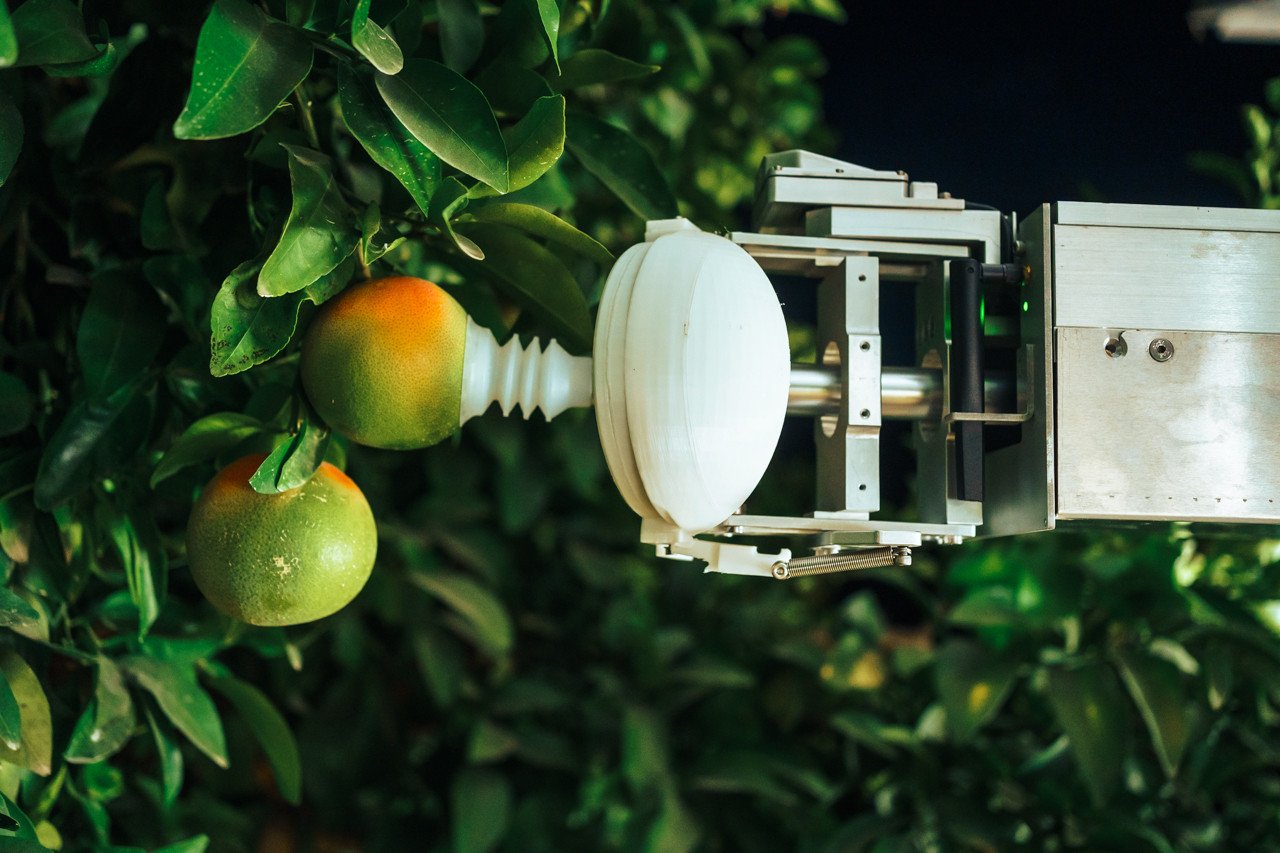
At the centre of Nanovel's technology is a proprietary harvesting system that combines computer vision, deep-learning algorithms and robotics. Its patented "Grip & Trim" mechanism uses telescopic robotic arms to identify fruit hidden deep inside tree canopies, gently grip individual fruit and cut the stem with precision to minimise damage—an essential requirement for premium fresh produce markets.
Unlike conventional robotic harvesters that rely on a single manipulator, Nanovel's platform simultaneously operates multiple robotic arms coordinated through a central onboard computer, allowing higher harvesting efficiency while remotely managing an entire fleet of machines.
Expanding global field trials
The company is now expanding field trials across Spain, Italy, Israel, and the United States, building on successful validation work conducted in California in partnership with the Citrus Research Board (CRB) during 2025. Although the first commercial application will focus on oranges and lemons, Nanovel plans to adapt the platform for additional citrus varieties as well as high-value fruit crops including mangoes, peaches and nectarines.
Agricultural robotics enters a new phase
The EIC award reflects a broader shift in agricultural technology investment, where robotics and artificial intelligence are increasingly viewed as practical solutions to structural labour shortages rather than experimental technologies. With Europe, North America and other major fruit-producing regions facing persistent workforce constraints, autonomous harvesting is emerging as one of the most closely watched segments within precision agriculture.
For Nanovel, the latest funding provides both financial backing and institutional validation as it moves from prototype development towards commercial deployment in one of agriculture's most technically challenging applications.