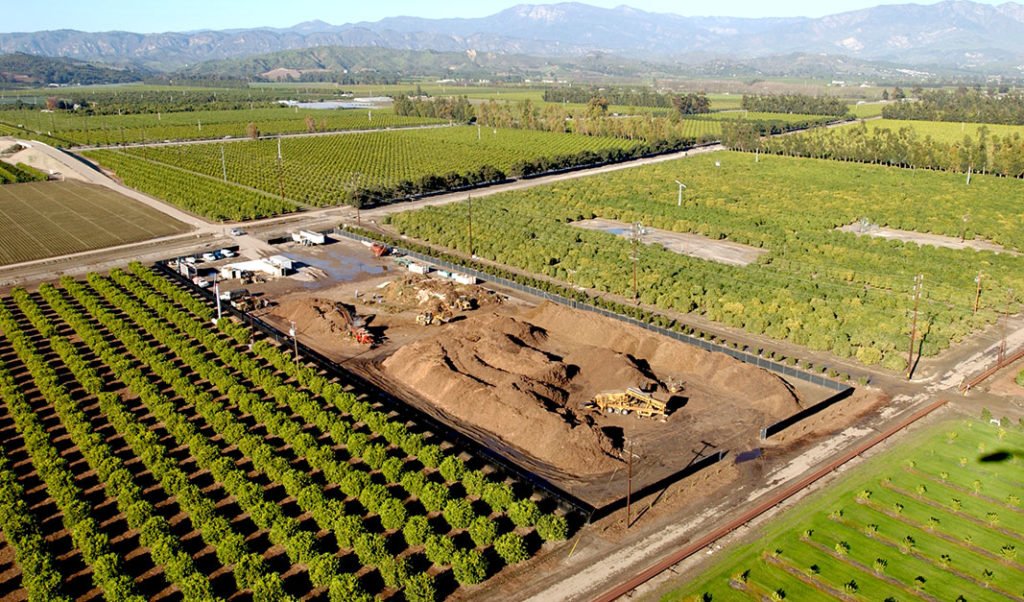
Agromin and Limoneira have cleared land for a new 70-acre commercial composting center in Santa Paula, California, marking a major expansion of organic-waste processing capacity in Ventura County.
The joint venture facility is expected to begin operations in the second half of 2027 and will be designed to process approximately 295,000 tons of organic waste annually. The facility will convert green and food waste into compost, mulch and other recycled materials, creating additional capacity for communities seeking to divert organic material from landfills.
The project expands Agromin’s existing 15-acre operation on the site, which has processed green waste since 2004. The current facility will remain operational during construction and is presently the only permitted commercial composting center in Ventura County.
Expanding California’s organic-waste infrastructure
The larger Santa Paula facility is being developed to process both green waste and food waste, responding to California’s growing need for infrastructure capable of handling organic materials outside the landfill system.
The project will support local communities working to meet the requirements of Senate Bill 1383, California legislation that calls for significant reductions in organic waste sent to landfills.
By increasing the volume of organic material that can be processed locally, the new facility is expected to strengthen the region’s capacity to recover nutrients and other valuable materials from waste streams.
The facility will produce compost and mulch for potential use in agriculture, landscaping and other applications, creating a circular pathway in which organic waste is converted into products that can return nutrients to soils.
50/50 joint venture creates multiple revenue streams
Agromin and Limoneira have established the project as a 50/50 joint venture. The business model is expected to generate revenue through waste-hauler gate fees as well as the sale of compost and other recycled materials.
The combination of waste processing and material sales provides the project with multiple commercial revenue streams while supporting California’s broader transition towards organic-waste recovery.
For Limoneira, the partnership also strengthens its involvement in agricultural sustainability and resource recovery. Agromin brings its experience in organic-waste recycling and compost production to the venture.
Food waste recycling expands
Agromin has also expanded its food-waste recycling operations elsewhere in Ventura County, including a dedicated facility in Oxnard.
The Oxnard operation converts collected food waste into a slurry that can subsequently be processed into products including renewable natural gas, fertilizers, animal feed and compost.
The expansion of the Santa Paula operation is expected to complement these activities by increasing the county’s overall capacity to process organic waste and recover value from materials that would otherwise enter the landfill stream.
Turning organic waste into agricultural resources
The project comes as California continues to invest in infrastructure designed to divert organic material from landfills and develop markets for recovered products.
Composting can play an important role in this transition by converting organic waste into soil amendments and other materials while reducing the volume of biodegradable waste requiring disposal.
Once operational, the Santa Paula facility is expected to become a significant regional processing hub, with an annual capacity of approximately 295,000 tons.
The project illustrates the growing convergence between waste management, agriculture and circular-economy infrastructure. By combining waste collection, organic processing and the production of compost and other recovered materials, the Agromin-Limoneira venture aims to create an economically viable pathway for transforming organic waste into useful agricultural and environmental resources.