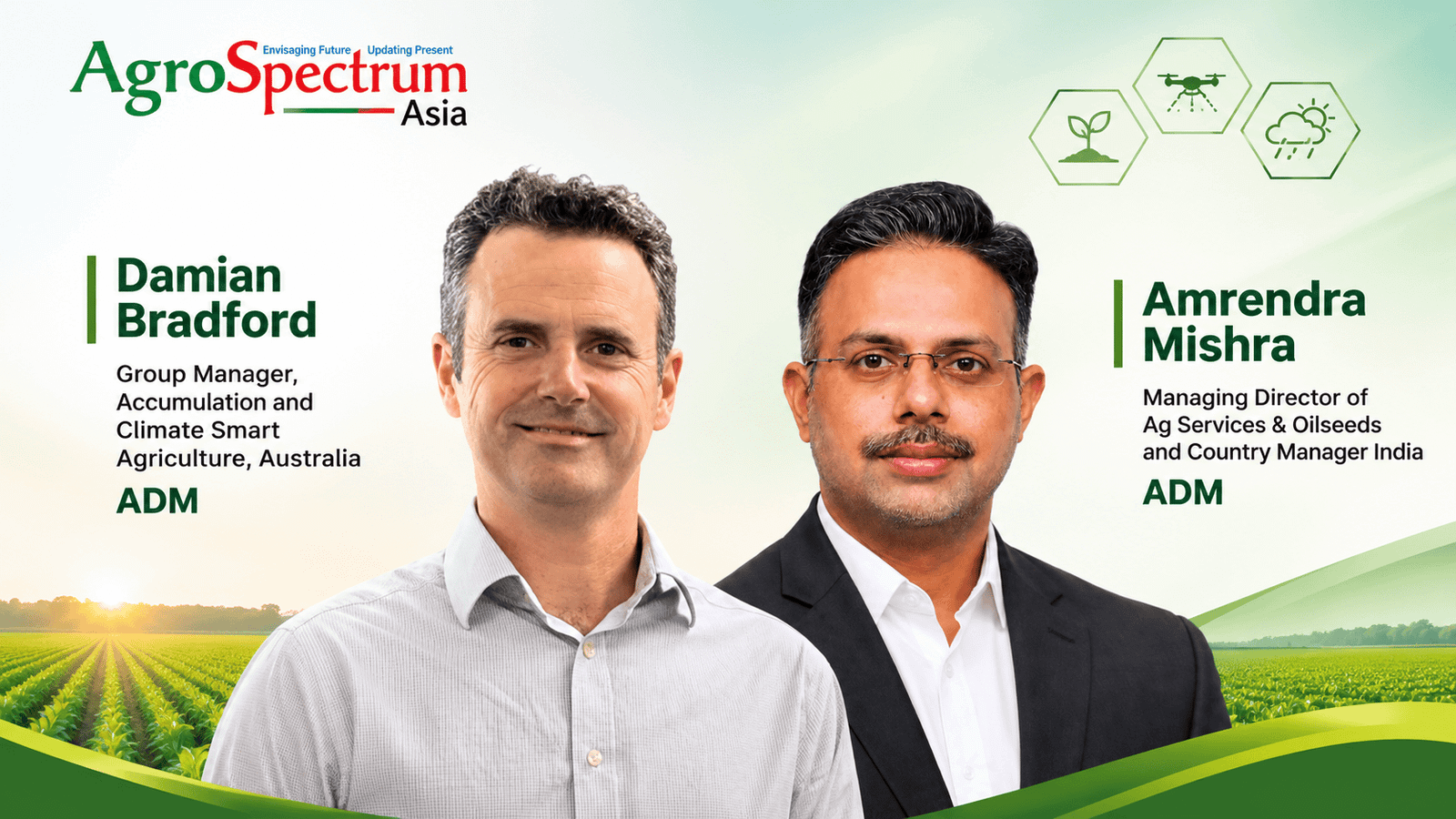
In an exclusive interview with AgroSpectrum, Damian Bradford, Group Manager, Accumulation and Climate Smart Agriculture, Australia, ADM, and Amrendra Mishra, Managing Director of Ag Services & Oilseeds and Country Manager India, ADM, discuss how regenerative agriculture is moving from sustainability commitments towards commercially viable farming and supply-chain models across Asia-Pacific. Drawing on ADM's experiences in India and Australia, they examine the distinct approaches required to scale regenerative agriculture across diverse farming systems, from India's extensive smallholder networks to Australia's certification-led cotton programmes.
The conversation explores how frameworks such as ProTerra and Regenagri are strengthening farm-level accountability, traceability and customer confidence in verified sustainable sourcing. It also examines whether growing corporate demand for regenerative commodities can translate into tangible economic incentives for farmers, beyond sustainability credentials and certification. With collaboration among agribusinesses, food manufacturers, policymakers and financial institutions emerging as a critical enabler, the discussion highlights what must change to make regenerative agriculture commercially sustainable. As ADM sets its sights on expanding its Indian programme to 100,000 soybean farmers by 2028, the interview offers an important perspective on the business models, partnerships and market mechanisms that could shape the next phase of regenerative agriculture across APAC.
ADM's regenerative agriculture programmes are developing across India and Australia, although at different scales and stages of maturity. What are the key factors shaping this growth, and how do the approaches to scaling differ between the two markets?
The growth of ADM’s regenerative agriculture programmes has been shaped by a combination of factors, including the need to strengthen farm and supply chain resilience, increasing customer demand for sustainably sourced agricultural commodities, and greater emphasis on traceability and verified outcomes. ADM’s ability to connect farmers with technical expertise, value-chain partners and end markets also plays an important role in supporting this growth.
At the same time, one of the key learnings from our work across markets is that there is no one-size-fits-all approach. While ADM applies the same regenerative agriculture definition and principles globally, programmes need to be locally relevant, with the flexibility to reflect different crops, climates, farming systems and farmer needs.
In Australia, our work has been driven through the ADM Regenagri Farm Group Licence, working with a relatively concentrated cotton grower base across New South Wales and Queensland. The model is built around certification, traceability and continuous improvement, with progress independently verified through Control Union audits.
In India, scaling has been built over multiple years through strong local networks and a broader ecosystem of partners across the agricultural value chain. ADM’s programme has established a five-year track record of certified sustainable achievements since 2021 and works with partners including Bayer Crop Science, Coromandel International Limited, Marathwada Krishi Vidyapeeth, Swayam Shikshan Prayog and local farming communities. These partnerships bring together scientific expertise and practical, locally relevant support for smallholder farmers. The programme has grown from around 25,000 soybean growers in 2024 to more than 53,000 farmers managing approximately 236,600 acres.
The programmes therefore require different models of engagement and support, but reinforce the same principle that successful regenerative agriculture programmes need to be designed around farmers and their local conditions.
How are certification frameworks such as Regenagri and supply-chain traceability helping bridge the gap between sustainable farming practices and commercial demand? Are customers increasingly willing to pay a premium for verified regenerative products?
Certification and traceability not only help bridge the gap between farming practices and commercial demand, but can also provide a common framework for stakeholders across the value chain to define, measure and verify sustainability outcomes. ADM applies the same regenerative agriculture definition and principles globally, while adapting its programmes to reflect different local farming systems and conditions. Within this broader approach, certification frameworks such as Regenagri in Australia and ProTerra in India help strengthen verification, traceability and transparency across agricultural supply chains.
In Australia, ADM supports growers through the ADM Regenagri Farm Group Licence, which enables participating farms to achieve certification under the internationally recognised Regenagri standard. Certification is centrally managed by ADM and independently verified through third-party audits conducted by Control Union. This provides customers with confidence that regenerative farming practices are being implemented and verified at the farm level.
In India, ADM has achieved five consecutive years of ProTerra certification since 2021, covering 53,000 smallholders and approximately 236,600 acres. The certification process has helped strengthen farm-level practices, governance and traceability throughout the supply chain. We are seeing growing customer interest in traceability, verified sustainability outcomes and visibility into how agricultural products are produced. While price remains an important consideration, there is also greater recognition of the value of regenerative agriculture beyond potential premiums. Verified practices and outcomes can help customers advance their sustainability goals and build greater transparency and resilience into their supply chains.
Continued customer demand will be important for regenerative agriculture to scale, particularly in creating market opportunities that encourage farmers to adopt and sustain these practices over time.
What role should agribusinesses, food manufacturers, policymakers and financial institutions play in accelerating commercial investment in regenerative agriculture across APAC? What needs to change for regenerative agriculture to become a commercially sustainable mainstream model?
Regenerative agriculture can scale faster when all parts of the value chain work together. Agricultural value chains are complex, spanning farmers, agribusinesses, technical and research partners, customers and other stakeholders. No single organisation can drive this transition alone.
Agribusinesses can help connect farmers with technical expertise, practical support and market opportunities, while food manufacturers play an important role in creating demand for agricultural commodities produced through regenerative practices. Policymakers can help create an enabling environment through supportive frameworks and investment, and financial institutions also have a potential role in improving access to financing that supports farmers through the transition.
Collaboration is already an important part of ADM’s approach in India, where we work with a broad ecosystem of partners, including Farmer Producer Organisations, NGOs, academic institutions and technical partners. These partnerships bring different capabilities together to help farmers access knowledge, scientific guidance, practical support and wider opportunities. Farmer engagement is also critical. Understanding farmers’ priorities and barriers helps ensure programmes and support are designed around what works in their local context. Ultimately, for regenerative agriculture to become a commercially sustainable mainstream model, it needs to deliver measurable value throughout the food and agriculture value chain.
For farmers, this means ensuring that adopting regenerative practices is economically viable and supports their long-term livelihoods. For ADM and other value chain partners, it means working together to scale regenerative agriculture in ways that support sustainability goals and create long-term value for businesses, customers and communities. Over time, improvements in areas such as soil health can help demonstrate the broader benefits of regenerative agriculture and contribute to more sustainable farming systems.
How does ADM envision the evolution of regenerative agriculture across Asia-Pacific over the next three to five years? Which markets, technologies and business models are likely to unlock the next phase of growth and commercialisation?
Over the next three to five years, we hope to see regenerative agriculture become a more established part of agricultural supply chains across Asia-Pacific, rather than being treated as a standalone sustainability initiative. In the near-term, the opportunity is about deepening participation within existing sourcing regions and enabling more farmers to adopt practices that work for their farms and local conditions.
In India, for example, ADM has built several years of experience working with smallholder farmers and partners across key soybean sourcing regions. The programme has grown from around 25,000 soybean growers in 2024 to more than 53,000 farmers today, with an ambition to reach 100,000 soybean farmers by 2028. Continued growth will depend on deeper farmer engagement, locally relevant support and strong ecosystem partnerships that bring together farmer organisations, technical experts, research institutions and other partners.
In Australia, we’re building on our Regenagri certification programme for cotton growers. In the 2024/25 season, ADM sold Regenagri-certified cotton grown across 19,964 acres of certified properties. The programme has since entered its second growing season, with 21,976 acres planted on Regenagri-certified farms in 2025/26, reflecting continued grower participation and commitment.
Looking ahead, stronger connections between farmers and end markets, supported by credible data, traceability and verification, will be important to sustaining progress. Digital capabilities and stronger outcome measurement can help strengthen transparency across agricultural supply chains, while growing customer interest for verified sustainability outcomes can create further opportunities for farmers to participate in regenerative agriculture programmes.