
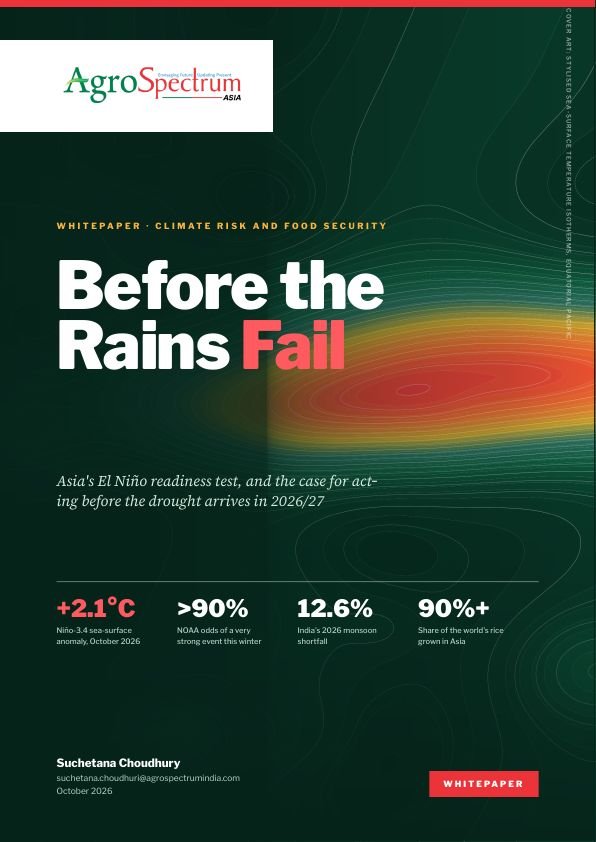
Whitepaper · Climate Risk and Food Security
Before the Rains Fail
Asia's El Niño readiness test, and the case for acting before the drought arrives in 2026/27.
Niño-3.4 sea-surface anomaly, °C above normal
+2.0 Oct 2026
+2.1 1997/98
+2.4 2015/16
+2.6
Free download
Get the full whitepaper
Charts, a country risk map of nine Asian farm economies, and an action agenda for governments, agribusiness, lenders and investors.
Your copy is ready
Thank you. Download Before the Rains Fail below. We have also noted your interest so we can share related briefings.
Download PDF · 2.7 MBWhy this matters now
The forecast is no longer the uncertainty
Science has given months of warning. The open question is whether governments, agribusinesses, lenders and farmers act on it in the weeks that remain.
Running hotter than forecast
NOAA's odds of a very strong event rose from 63% in June to above 90% by September, with a 75% chance of a record-breaking peak.
India has taken the first blow
The southwest monsoon ended 12.6% short. East and Northeast India had their driest season since records began in 1901.
Southeast Asia's test is 2027
Heaviest farm damage usually lands between February and May of the second year, leaving a short window to prepare.
Explore the data
A preview of the evidence
Three of the charts from the whitepaper. Hover for values; the full report carries the analysis behind each one.
Country risk explorer
Nine farm economies, one Pacific signal
Select a country to see its main exposure, what to watch, and when the pressure peaks. The whitepaper covers each in depth.
- Main exposure
- What to watch
- Pressure window
- Readiness lever
Ratings are an AgroSpectrum Asia editorial assessment based on NOAA, WMO, FAO, WFP, UNDP and IMD sources.
What's inside
Seven sections, one action agenda
Written for executives who need the picture fast and the evidence to act on it.
Where Things Stand
A one-page data briefing: the Pacific, India's monsoon, the 2027 window and market positioning.
Page 5Understanding El Niño
How a Pacific anomaly becomes a food, water and income crisis, with lessons from 1997/98, 2015/16 and 2023/24.
Page 9Mapping Agricultural Risk
Country by country, from India's rain-fed belts to the Mekong Delta and East Asia's heat problem.
Page 13Government Readiness
Who is turning forecasts into decisions, and the four gaps that still separate warning from action.
Page 19Adaptation as an Investment Theme
Biologicals, precision irrigation, resilient seed, climate intelligence and the US$215 to 387bn a year finance gap.
Page 22The Road Ahead
A 6 to 12 month action agenda for governments, agribusinesses, banks, investors and farmer groups.
Page 25Executive Summary and Sources
The bottom line in two pages, with every figure traced to its source.
Pages 3 and 28Look inside
Designed for the boardroom
Data pages, chapter briefings and a country risk grid built to be read in minutes and shared with your team.
Who should read it
Built for the people who decide early
Each chapter ends with what the reader can do in the next six to twelve months.
Governments
Forecast-based triggers that release seed, feed, water and cash before damage hits.
Agribusinesses
Stress-testing sourcing for a very strong El Niño and co-investing with suppliers in resilience.
Banks and insurers
Index cover, satellite pricing and contingent credit for farmer producer organisations.
Investors
Where adaptation capital is concentrating: water productivity, resilient genetics and climate data.
Free whitepaper
Act before the rains fail
Acting before a drought is cheaper and more effective than responding after crops, herds and savings are gone. Get the evidence and the action agenda in one report.
Download the whitepaper